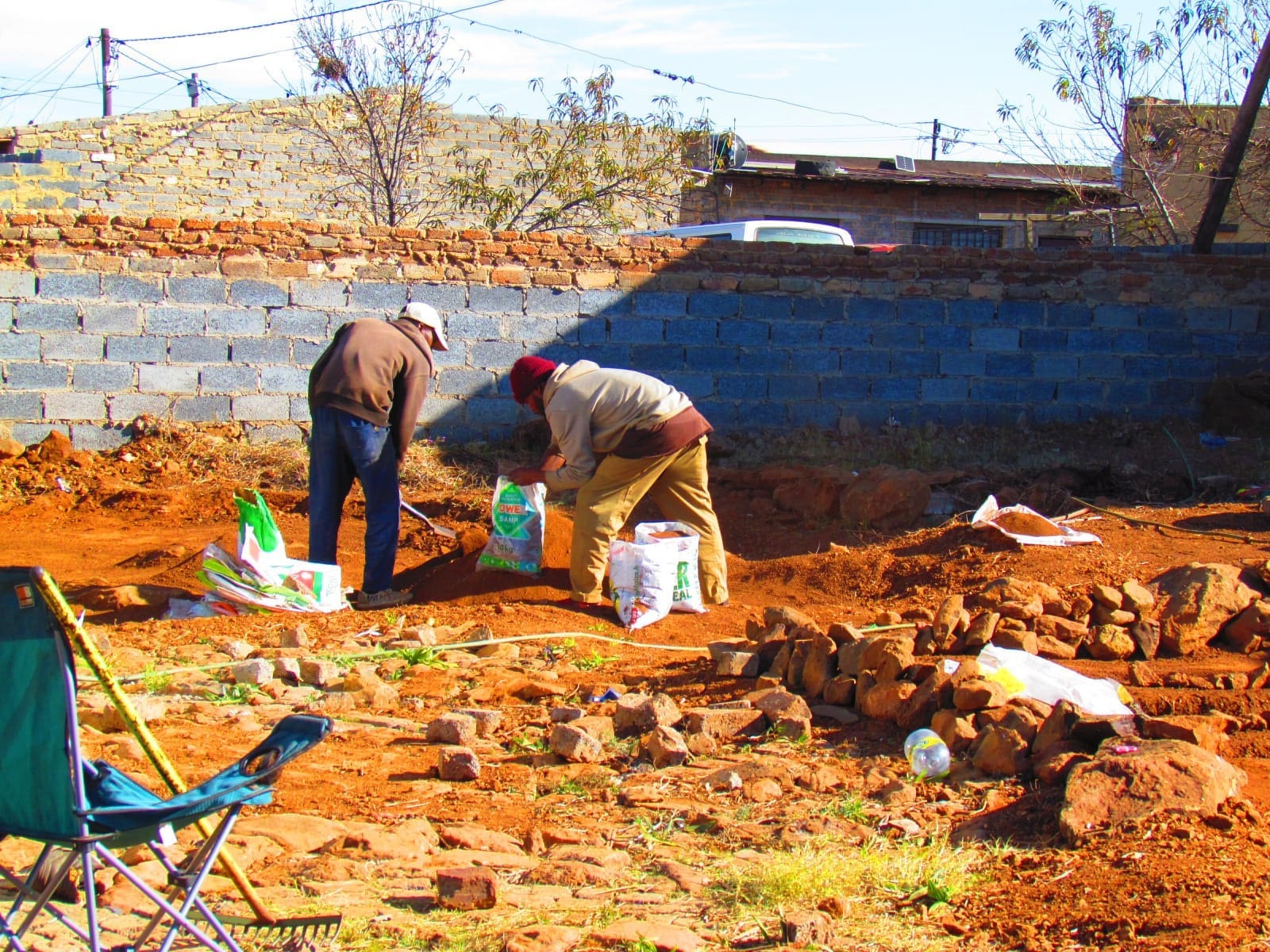
In Orange Farm Ext 1, near Lakeside Park, two young creatives are testing a simple idea: whether small-scale farming can help address two persistent challenges in the community – food insecurity and youth unemployment.
Vusumuzi Nkosi, 30, a professional printmaker and contemporary visual artist, and Mpho Jeffrey Rikhotso, 24, a music producer and entrepreneur, started a potato farming project earlier this year using their own savings.
So far, they have planted about 400 bags of potatoes. Their next target is more than 1,000 bags.
Rather than waiting for formal employment opportunities, the pair are trying to turn available land into a source of food, income and possible future work.
“We are artists, but we also believe in food security. In our area, many families struggle and many young people have no jobs. We want to show that land is a job if you work it,” they said.
Their approach is still small and developing, but it shows how young people can combine existing skills, personal resources and locally available land to begin building an alternative livelihood.
Nkosi’s background is in visual art, where his work focuses on the struggles and joys of township childhood through linocut prints and paintings. Rikhotso comes from music production and entrepreneurship. Neither started the project with outside agricultural funding.
Instead, they used money earned through their creative work to buy initial farming inputs and begin planting.
That self-funded start is one of the project’s strengths, but it is also one of its biggest limitations.
The farmers say expanding from 400 to more than 1,000 potato bags will depend on access to additional inputs, water infrastructure and agricultural knowledge.
They are currently seeking seed potatoes, compost or manure, soil, grow bags, a JoJo tank, irrigation pipes, watering cans and other farming equipment. They are also appealing for financial support, training and mentorship.
If those resources are secured, the pair believe the project could increase production and potentially create opportunities beyond their own involvement.
Their longer-term goal is to show other young people in Orange Farm that agriculture can be approached not only as subsistence farming, but as a practical form of entrepreneurship.
The project also offers a model that could be replicated on a small scale: start with available land, use manageable planting methods such as farming bags, reinvest earnings and expand production as resources become available.
However, its success will depend on more than enthusiasm.
Reliable access to water, suitable inputs, farming knowledge, market access and consistent production will determine whether the project can grow into a sustainable source of income and employment.
For now, Nkosi and Rikhotso are inviting potential sponsors, agricultural organisations and experienced farmers to visit the site, assess what they are doing and offer practical support.
They also say sponsors will be acknowledged through their social media platforms, while community members and potential partners are welcome to visit the farm and verify the project firsthand.
Their effort is still in its early stages, but it represents a locally driven response to a broader problem: young people creating their own opportunities instead of relying solely on jobs that may not be available.
For Nkosi and Rikhotso, the move from art and music into farming is not about abandoning creativity. It is about applying the same determination in a different space — from canvas and studio to soil and food.
Those interested in sponsorship, mentorship, site visits or orders can contact Vusi on 079 060 2337 via call or WhatsApp.