












Against the odds in a township backyard in Orange Farm, Mother Tongue Wednesdays are showing that literacy can grow anywhere – if it begins in the language of home
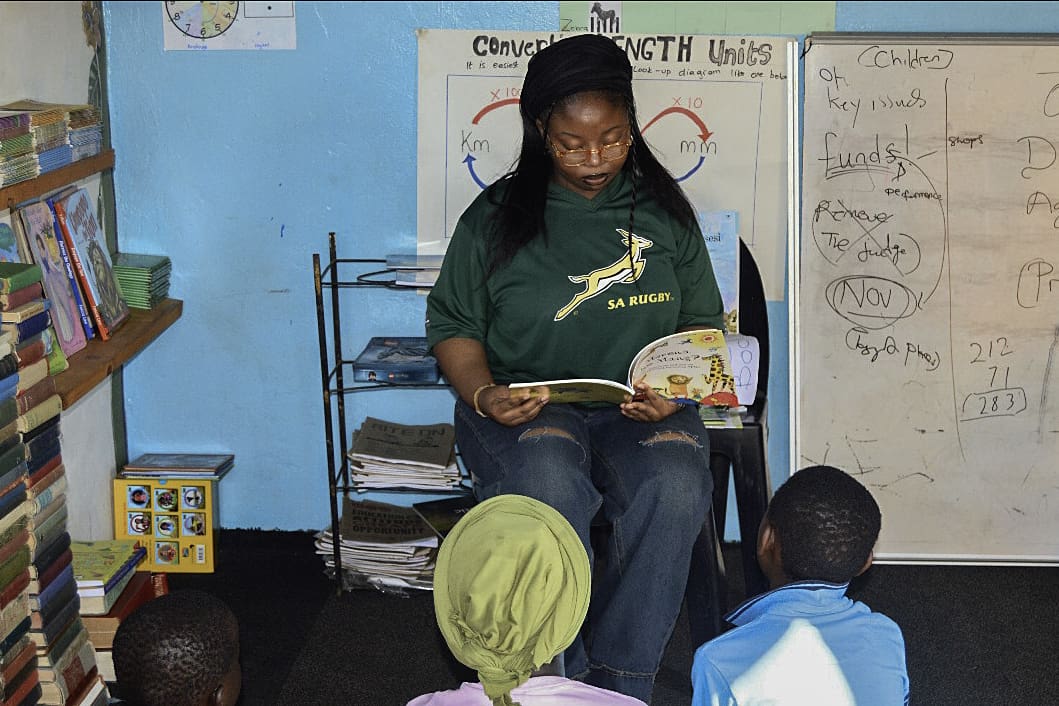
The chatter of children’s voices rises from behind a corrugated gate on a Wednesday afternoon in Drieziek 3, Orange Farm. Inside a small backyard building that was once a storeroom, rows of plastic chairs and low desks fill the space. Here, Abantu Literacy League hosts its weekly ritual: Mother Tongue Wednesdays, a day when English gives way to the languages of home – isiZulu, Sesotho, and to a lesser extent Sepedi, Tshivenda and Xitsonga.
The League was founded last year by a group of volunteers who identified a gap in their community: outside of schools, few public spaces encouraged reading and literacy. On a mission to promote reading and literacy and a vision to make reading “cool” and books accessible, the centre supports 30 learners, aged 6 to 14, from Itemoheng Primary, Rekgutlile Primary, Govan Mbeki Primary, Thetha Secondary and Solwazi Primary.
Volunteer teacher, Senelisiwe Ngubeni, an Arts and Visual Studies graduate, says: “Wednesdays are for mother tongue, we teach in Isizulu and Sesotho. Looking at some learners who attend here, we noticed that schools are not doing enough when it comes to mother-tongue teaching, so we do what we can after hours.”
The League’s work has national relevance in light of the Department of Basic Education’s Funda Uphumelele National Survey (FUNS) findings this week that fewer than a third of children in South Africa read fluently in their home languages (HL) by Grade 3, with 15% not reading a single word. A year later, fewer than half are on track. Figures for Gauteng province are higher, at 32% in Grade 3 and 62% by Grade 4.
A key theme emerging from the FUNS briefings was that foundation phase learners do not spend enough time reading, which negatively impacts their confidence, fluency, and comprehension over the long term.
The FUNS findings underline why community initiatives like the League’s Mother Tongue Wednesdays provide a lifeline for early readers.
The League’s approach mirrors research by Elizabeth Pretorius, Professor Emeritus and Research Fellow in the Department of Linguistics and Modern Languages at the University of SA (UNISA).
Pretorius’s studies show that reading in a familiar language frees working memory – decoding becomes effortless, leaving space for meaning.
To encourage participation, commitment and also test progress, every Friday, the League holds spelling, reading, and storytelling contests – no prizes, just pride. The League’s motto is simple: “Reading is a right, not a privilege.”
Ngubeni says: “Children can speak isiZulu or Sesotho, but when you ask them to read or write in those languages, they struggle. Most know words in English but not in IsiZulu or Sesotho. Learners grasp more when you explain in their home language, “It’s slower, but it stays with them.”
South Africa’s literacy challenge is as urgent as it is complex. Although the DBE promotes mother-tongue instruction through Mother Tongue-based Bilingual Education (MTbBE) many schools switch to English early – often in Grade R. Parents push for it, believing English equals opportunity. But comprehension falters when children are taught in a language they don’t yet understand.
Echoing literacy models elsewhere in Africa
Equipped with little more than donated books and chalk, the League has created structure, routine and connection, illustrating that literacy progress is more than about budgets, but also passion and purpose.
What began as a small homework club has grown into a grassroots literacy hub. Every week, the League’s facilitators transform the backyard into a multilingual classroom through:
Routine: scheduled reading and spelling in home languages.
Joy: songs, storytelling, and playful repetition.
Togetherness: parents reading alongside their children.
The League’s achievements echo successful literacy models across Africa, though these are often done on a better-resourced, larger scale.
In Kenya, the Tusome Programme (“Let’s Read”) combined daily reading schedules, local-language books, and teacher coaching – doubling comprehension within five years.

In Uganda, the Literacy and Adult Basic Education (LABE) project trains parents to help children read at home in indigenous languages, achieving significant fluency gains among participating learners.
Elsewhere in South Africa, initiatives like Funda Wande and Grow ECD are demonstrating that teaching in home languages – supported by structured phonics and mentoring – dramatically improves reading comprehension and confidence.
Tangible results: Reading with pride
Ngubeni has noted a visible change in participants, with the league’s reading sessions becoming community events – spaces of pride and laughter. Children who once mumbled through sentences can now read isiZulu and Sesotho stories aloud, sometimes translating them line by line. Parents join too – some sitting cross-legged on the floor, clapping along while reading out the words for songs. “Parents always share how their children used to hide homework because they couldn’t write correctly, but thanks to our programme they have improved,” says Ngubeni.
The Limitations: Too few books, too many barriers
A 2025 UNESCO report, Languages matter: Global guidance on multilingual education, highlights the urgent need to include multilingualism in education systems so that children learn in a language they understand.
Pretorius warns that “mother-tongue instruction alone is no magic bullet – it needs material, coaching, and assessment to work.”
While the League is overflowing with enthusiasm, it lacks resources and reading materials. The centre has a handful of isiZulu and Sesotho books, many taped together after years of use; five children often share one book. Languages like Tshivenda and Xitsonga are scarcely represented.

Ngubeni says the shortage holds learners back. “We need more mother-tongue materials – stories, poems, even comic books,” she pleads. “Children learn faster when they see their language in print. If publishers and authors create more local-language books, more children across township centres like ours will be inspired to learn and teach in their own languages,” Ngubeni adds.
The League is small, informal, and lacking donor support, yet it is providing answers to the reading crisis: citizen participation, consistent practice, and cultural pride.
Its backyard classroom has become a living laboratory for what Pretorius calls “decoding identity” – learning not only to read, but to understand oneself through language
As the session ends and the children leave, Ngubeni closes the gate and tidies the classroom. “It’s not perfect,” she says, stacking a pile of books with worn corners. “But it’s real. If every community had a space like this – a backyard where reading lives – we’d be a country that truly reads.”
- This article is part of a series that has been produced with the support of the Henry Nxumalo Foundation. See Part 1 here…


